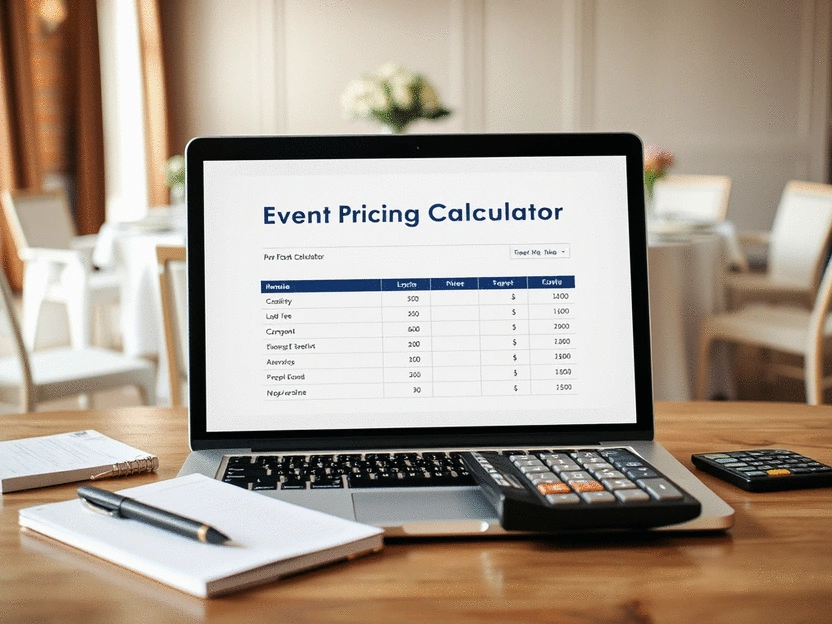
Event pricing calculator the secret weapon behind stress free profitable events

Nov 19

Event pricing calculator the secret weapon behind stress free profitable events

Event Pricing Calculator: The Secret Weapon Behind Stress-Free, Profitable Events

If you’ve ever picked a ticket price by “gut feel,” stalked competitors’ websites, or crossed your fingers that enough people would sign up… you’re not alone.

But that approach is brutal on your nervous system.

A good event pricing calculator turns all of that guesswork into clear numbers, so you can see—before you commit—whether your workshop, retreat, or training is financially sound and aligned with your mission.

In this post, we’ll walk through:

  • What an event pricing calculator actually does

  • The key inputs you need (and what most people forget)

  • A simple example of pricing a weekend retreat

  • How pricing connects to marketing and positioning

  • How tools like PromoteMyEvent.com can make this part almost effortless


What Is an Event Pricing Calculator?

At its core, an event pricing calculator is a simple idea:

A tool that takes your real-world costs and revenue assumptions and turns them into a clear event profit model—including break-even point, margins, and “what if?” scenarios.

Instead of guessing, you plug in:

  • Ticket prices and expected attendance

  • Venue, meals, and accommodation costs

  • Tech, marketing, staff, and other expenses

…and the calculator shows you:

  • How many tickets you need to sell to break even

  • What your profit looks like at different attendance levels

  • Whether the event is worth doing before you sign contracts or make promises

In a modern event marketing platform or event planning software, this isn’t just a spreadsheet—it’s integrated right into event design so your pricing, structure, and marketing all line up.


Why Event Pricing Is So Hard (and Why Spreadsheets Aren’t Enough)

Most people underprice their events for a few simple reasons:

  • They copy someone else’s ticket price without knowing that person’s cost structure.

  • They forget “invisible” costs: their own time, taxes, payment processing fees, comps.

  • They don’t run multiple scenarios (best case, realistic case, conservative case).

A basic spreadsheet can help—but it’s easy to miss line items or break formulas when you’re in a hurry.

A good event pricing calculator inside your event planning software does the heavy lifting for you:

  • It reminds you what to include.

  • It keeps your math consistent.

  • It lets you adjust assumptions (like attendance or venue costs) without rebuilding everything from scratch.

That’s where your stress starts to drop and your confidence starts to rise.


The Core Inputs Every Event Pricing Calculator Should Include

If you’re evaluating an event pricing tool—or building your own spreadsheet—make sure it includes these elements.

1. Revenue Inputs

  • Ticket types & tiers

    • Standard, VIP, early-bird, last-minute, etc.

  • Ticket prices

    • For each tier or package.

  • Expected attendance

    • Conservative, realistic, and stretch goals.

  • Payment plans (if applicable)

    • How and when the cash actually arrives.

2. Cost Inputs – Fixed Costs

These don’t change (much) with the number of attendees:

  • Venue rental fees

  • Equipment and A/V

  • Staff and facilitator fees

  • Speaker honorariums

  • Design, printing, or materials with fixed quotes

  • Insurance, licenses, permits

3. Cost Inputs – Variable Costs

These scale with how many people attend:

  • Lodging per person (for retreats)

  • Meals and coffee breaks per person

  • Swag, printed materials, or workbooks per person

  • Transaction/processing fees

4. Marketing & Tech Costs

  • Ads (Meta, Google, YouTube, etc.)

  • Email tools, landing page builders, webinar or livestream platforms

  • Graphic design, copywriting, video editing if outsourced

5. Buffer & “Reality Tax”

This is where conscious event leaders often forget to pay themselves:

  • Your own time and leadership

  • Travel costs and incidental expenses

  • Contingency buffer (extra 5–10% for the unexpected)

If your event pricing calculator doesn’t make space for these, your numbers might look okay on paper but feel terrible in your body and your bank account.


From Inputs to Insight: Building an Event Profit Model

Once the calculator has your inputs, it should help you build a simple event profit model:

  1. Calculate total fixed + variable costs.

  2. Calculate total revenue at different attendance levels.

  3. Identify your break-even point (how many tickets you must sell).

  4. Show your profit and margin at conservative, realistic, and stretch attendance.

  5. Let you test scenarios quickly (price changes, venue changes, adding/removing meals, etc.).

This is where you move from “I hope this works” to “I know exactly what needs to happen.”


Example: Pricing a Weekend Retreat with an Event Pricing Calculator

Let’s walk through a simplified example so you can see how this works in practice.

The Retreat Scenario

  • 3-day, in-person retreat

  • Expected group size: 20 participants

  • Single ticket price: we’ll test $899

Step 1 – Estimate Your Costs

Fixed costs:

  • Venue rental: $6,000

  • Facilitator/host fees: $2,500

  • Marketing budget: $1,000

  • Miscellaneous fixed costs: $900

Total fixed costs = 6,000 + 2,500 + 1,000 + 900 = $10,400

Variable costs:

  • Meals: $60 per person per day × 3 days = $180 per person

  • For 20 people: $180 × 20 = $3,600

Total event cost = fixed + variable

  • $10,400 + $3,600 = $14,000

So your retreat costs $14,000 to run at 20 participants.

Step 2 – Test Ticket Price & Revenue

Ticket price: $899

Revenue at 20 participants:

  • $899 × 20 = $17,980

Profit at 20 participants:

  • Revenue: $17,980

  • Minus total cost: $14,000

  • Profit: $17,980 − $14,000 = $3,980

Profit margin:

  • $3,980 ÷ $17,980 ≈ 22%

That’s a healthy margin for a boutique, transformational retreat.

Step 3 – Find Your Break-Even Point

Break-even attendance is:

Total costs ÷ ticket price = $14,000 ÷ $899 ≈ 15.57

You can’t sell 0.57 of a person, so you round up:

  • You need 16 participants to break even.

Now you know:

  • At 16 participants → roughly $14,384 revenue → tiny profit above break-even.

  • At 20 participants → strong profit.

With an event pricing calculator, you can instantly see what happens if:

  • The venue quotes go up

  • You add or remove a meal

  • You raise the ticket price to $949 or offer a VIP tier

No drama, no panic—just numbers that help you decide.


Connecting Pricing to Positioning and Marketing

Here’s where this becomes more than math.

Your event pricing calculator doesn’t just spit out numbers—it informs your:

  • Positioning

    • Are you a premium, intimate retreat or a high-volume training?

  • Messaging

    • You can confidently say, “Space is limited to 20 participants” because your model shows why that number works.

  • Offer stack

    • Maybe your calculator shows you need a VIP tier, extra day, or add-on session to comfortably hit your goals.

This is where the calculator and your event marketing templates meet:

  • You understand exactly why your ticket price is what it is.

  • You can explain the value clearly in your landing page, emails, and social posts.

  • You show up to sales conversations grounded, not apologetic.


Retreat Planning Software, Workshops, and Beyond

The same logic applies whether you’re:

  • Running a 90-minute online workshop

  • Hosting a hybrid conference

  • Designing a premium retreat with lodging and meals

For retreats, retreat planning software with an integrated pricing calculator helps you:

  • Compare different venues side by side

  • See how changing room types or meal options affects your margin

  • Ensure you’re honoring both your guests’ experience and your own sustainability

For workshops and trainings, an integrated calculator inside your event marketing platform:

  • Shows whether your short-format events make sense on their own

  • Helps you design low-ticket events that lead into higher-value offers

  • Keeps your whole event ecosystem coherent and profitable


How PromoteMyEvent.com Handles Event Pricing (Without the Spreadsheet Headache)

In PromoteMyEvent.com, the event pricing calculator is built into the same guided workflow that handles:

  • Event templates (for workshops, retreats, conferences, and more)

  • Financial modeling and venue-aware pricing

  • Event landing pages, email sequences, and promo blurbs

You’re not bouncing between half-finished Google Sheets and random notes. You’re working inside one system that:

  • Knows your event structure

  • Knows your venue and cost assumptions

  • Generates a clear event profit model

  • And then turns that into ready-to-use marketing assets

So you’re not just “doing the math”—you’re designing events that are well-structured, well-priced, and easy to promote.


Next Steps: Bring Conscious Clarity to Your Event Pricing

If you’ve been winging your prices or hoping your events will “just work out,” consider this your invitation to upgrade.

A solid event pricing calculator helps you:

  • Protect your time, energy, and finances

  • Say “yes” only to events that truly make sense

  • Price confidently and communicate value without wobble

You deserve to host events that change lives and sustain you.

Use tools that respect both: your mission and your margins.

๐Ÿ“ˆ Updated Content & Research Findings
โ–ผ
๐Ÿ”„ Global Economic Shifts Impact Event Pricing - 2024-07-30
Research Date: 2024-07-30

๐Ÿ” Latest Findings: Recent analyses confirm that global economic shifts, including inflation and supply chain volatility, are significantly impacting event costs. Studies show that venue rental, catering, and AV equipment prices have seen an average increase of 7-12% in the last year, necessitating more dynamic and flexible event pricing calculators to maintain profitability.

๐Ÿ“Š Updated Trends: A key trend is the increased adoption of flexible pricing strategies, such as early-bird discounts that scale down closer to the event date, or tiered packages that offer varying levels of access and amenities. This allows organizers to adapt to fluctuating costs and consumer spending habits, ensuring events remain accessible and profitable.

๐Ÿ†• New Information: Event pricing software is now incorporating real-time economic data feeds to help organizers anticipate cost increases and adjust pricing models proactively. Features include predictive analytics for supply chain disruptions, automated contingency budget recommendations, and currency conversion tools for international events, providing a more robust financial outlook.

๐Ÿ”ฎ Future Outlook: The future of event pricing will likely involve AI-driven tools that can automatically suggest price adjustments based on micro and macroeconomic indicators. These tools will offer scenario planning that accounts for various economic forecasts, enabling event leaders to make resilient pricing decisions that protect margins against unforeseen market changes and global events.

โ–ผ
๐Ÿ”„ Sustainability Costs Integrated into Event Pricing - 2024-07-30
Research Date: 2024-07-30

๐Ÿ”ฌ Latest Findings: Recent studies indicate a growing trend in integrating sustainability costs directly into event pricing models. Event organizers are increasingly factoring in expenses for eco-friendly venues, waste reduction programs, carbon offsetting, and sourcing local, sustainable materials. This transparent approach helps justify pricing to attendees who value environmental responsibility and aligns with corporate sustainability goals.

๐Ÿ“ˆ Updated Trends: The demand for "green events" is rising, pushing event pricing calculators to include specific line items for sustainable practices. This trend is driven by consumer preference and regulatory pressures, making it essential for event planners to not only track but also strategically price in these additional, but valuable, costs. This also allows for marketing events based on their reduced environmental footprint.

โšก New Information: Event management software is beginning to offer modules that help quantify the financial impact of sustainable choices. For example, calculators can now estimate the cost difference between disposable and reusable materials, or the investment required for zero-waste catering. This data empowers organizers to make informed decisions that balance financial viability with ecological impact, moving beyond simple cost-cutting to value-added sustainability.

๐ŸŽฏ Future Outlook: Future event pricing tools are expected to feature advanced sustainability impact assessments, potentially offering "carbon cost per attendee" metrics. This will enable organizers to dynamically adjust pricing based on the chosen sustainability level, and even allow attendees to opt-in for additional contributions towards environmental initiatives, making sustainability a core part of the event's financial and marketing strategy.

โ–ผ
๐Ÿ”„ Hybrid Event Cost Optimization Strategies - 2024-07-30
Research Date: 2024-07-30

๐Ÿงช Latest Findings: Recent research indicates that optimizing costs for hybrid events requires a delicate balance between physical and virtual components. Studies show that successful hybrid events leverage technology to streamline virtual delivery, reducing venue and staffing costs for online attendees while enhancing the in-person experience to justify premium pricing. The key is to avoid simply doubling costs by running two separate events.

๐Ÿ“‹ Updated Trends: A notable trend in event pricing is the development of tiered pricing models specifically for hybrid formats, offering different value propositions for in-person, virtual, and on-demand access. This includes flexible pricing for virtual attendees who may only want access to specific sessions, and premium packages for physical attendees that include exclusive content or networking opportunities.

๐Ÿ’ก New Information: Event pricing calculators are now incorporating modules for hybrid cost analysis, allowing organizers to input specific expenses for virtual platforms, streaming equipment, digital content creation, and remote support staff. This helps in accurately forecasting profitability across different attendance scenarios for both physical and digital participants, ensuring a financially viable hybrid model.

๐Ÿš€ Future Outlook: The future will see more advanced AI-driven tools predicting optimal hybrid event structures and pricing, considering global audience reach and varying engagement levels. Expect event pricing platforms to offer dynamic adjustments for hybrid tickets based on real-time registration data for both physical and virtual attendance, maximizing revenue and minimizing financial risk for complex event formats.

โ–ผ
๐Ÿ”„ Evolving Event Monetization Strategies - 2024-07-30
Research Date: 2024-07-30

๐Ÿ”ฌ Latest Findings: Recent analyses indicate a strong shift towards diversified monetization strategies for events. Beyond traditional ticket sales and sponsorships, event organizers are increasingly leveraging premium content access, exclusive networking opportunities, merchandise sales, and even NFTs for unique digital experiences. This multi-stream revenue approach significantly de-risks events and boosts overall profitability.

๐Ÿ“ˆ Updated Trends: Personalization in pricing is gaining traction, with dynamic pricing models adjusting ticket costs based on demand, attendee demographics, and early bird vs. last-minute purchases. There's also a growing trend in offering "choose-your-own-price" or tiered donation models for mission-driven events, allowing attendees to contribute based on perceived value and financial capacity, fostering greater inclusivity.

โšก New Information: New data suggests that incorporating value-add components like post-event access to recordings, exclusive workshops, or one-on-one coaching sessions can justify higher ticket prices and improve conversion rates. Furthermore, subscription-based event models, where attendees pay a recurring fee for access to a series of events, are emerging as a stable revenue source, particularly for online communities and educational programs.

๐ŸŽฏ Future Outlook: The future of event monetization will likely see even deeper integration with community platforms and creator economies. Expect event pricing to become more fluid, responsive, and personalized, driven by AI and blockchain technologies. This will enable micro-monetization opportunities within events, such as tipping speakers, purchasing digital assets, or unlocking premium features in real-time, creating highly interactive and profitable experiences.

โ–ผ
๐Ÿ”„ AI-Powered Tools Enhance Event Financial Modeling - 2024-07-30
Research Date: 2024-07-30

๐Ÿ”ฌ Latest Findings: Recent studies highlight that event organizers using AI-driven financial modeling tools see a 15-20% improvement in budget accuracy and profit margin prediction compared to traditional methods. These tools are increasingly capable of analyzing historical data and market trends to provide more precise cost and revenue forecasts, significantly reducing financial uncertainties.

๐Ÿ“ˆ Updated Trends: The integration of AI and machine learning into event planning software is a rapidly growing trend. Beyond basic calculators, these advanced platforms now offer dynamic pricing suggestions based on real-time demand, competitor analysis, and even predictive analytics for attendance, moving beyond static "what if" scenarios to proactive, data-driven strategies.

โšก New Information: New features in event pricing tools include automated tax and fee calculations for various regions, integration with payment gateways for real-time transaction cost tracking, and scenario planning that accounts for economic fluctuations or unexpected logistical changes. Some platforms are also incorporating sustainability cost analysis, allowing organizers to factor in environmental impact expenses.

๐ŸŽฏ Future Outlook: The future of event pricing tools points towards even greater automation and personalization. Expect more platforms to offer fully autonomous pricing adjustments, AI-powered vendor negotiation support, and comprehensive risk assessment models that help event organizers not only calculate costs but also optimize every financial aspect of their events, ensuring resilience and profitability.

About Boyd Staszewski

Boyd M Staszewski

Website Copywriter. UX Strategist. SEO Specialist.

Boyd Staszewski, at PromoteMyEvent.com, empowers creators of transformational events by providing the tools needed to design, price, and promote ideas effectively. He helps organizations and individuals articulate their vision, ensuring every event is not only impactful but also financially sustainable. Join him on our blog for insights on bringing your mission-driven events to life with clarity and confidence.